Color gamuts and display devices – now you know!
March 7, 2024
Sit back, relax, and keep reading, as the following lines will explain things in a simple and understandable way—things you may never have had the chance to learn before.What is light?Light is electromagnetic radiation emitted as waves by the electromagnetic field and distributed throughout the universe. These waves consist of oscillating electric and magnetic fields that travel at the speed of light—about 299,792 kilometers per second (or approximately 186,282 miles per second) in a vacuum.
Imagine these electromagnetic waves like a ping pong ball. The more bounces it makes on the table as it moves, the shorter the wavelength of the electromagnetic wave, and vice versa.
By measuring the distance between these bounces, we can determine the type of "light" with great accuracy. And guess what? We have managed to measure the entire spectrum of these waves and found that their length (the distance between "bounces") ranges from 100 meters to 0.0001 nanometers (one nanometer is a billionth of a meter!).
To give you an idea: this spans from the size of a large building (100 m) to the size of a single atom (0.0001 nm).
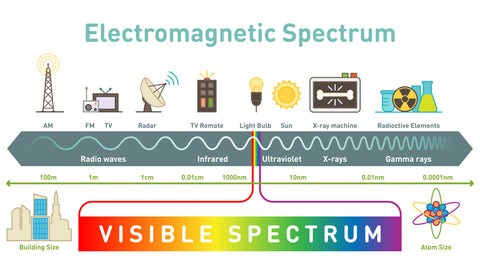
This is the entire spectrum of these electromagnetic radiation waves. This is what we call light.
Now you have just discovered why, for example, TV or FM signals travel at the speed of light – because they are light! We just can't see them!What is visible light?Visible light is only a small part of this electromagnetic radiation that our eyes can detect and decode. Think of our eyes as specialized biological devices that perceive only this narrow spectrum of these waves and ignore everything else.
From the vast range of the full light spectrum (waves from 0.0001 nanometers to 100 meters), we see only a very small portion—specifically, the light waves between 380 and 740 nanometers! This is visible light.
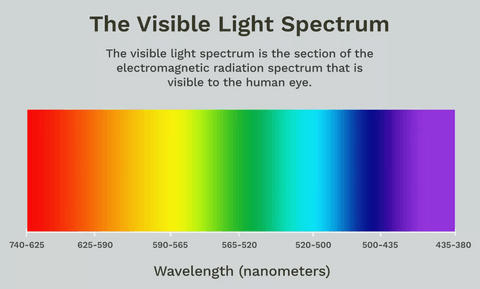
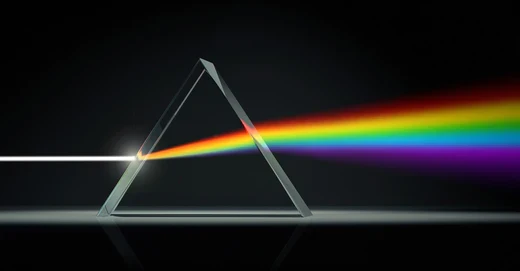
ColorsThis small visible portion of light, when separated into its components by a prism, consists of 6 colors with wavelengths between 380 and 740 nanometers.
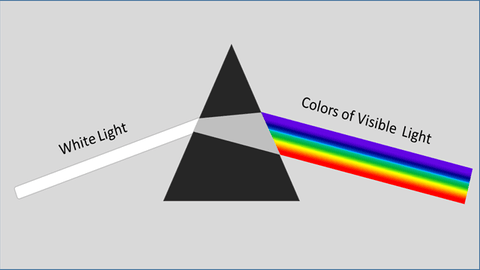
When we pass a beam of light through a prism, colors appear.
These are the colors that humans can see in our physical environment. These are the specific electromagnetic waves our eyes are designed to receive and decode.
We call them the three primary colors (red, green, blue) and the three secondary colors (yellow, cyan, magenta). By mixing these six colors, we can create all the shades we can imagine.
Let’s call this the "natural color gamut".Color gamut – CIE 1931An international scientific organization founded in 1913 (the International Commission on Illumination - CIE) succeeded in 1931 in capturing this "natural color gamut" with a mathematical model in the form of a diagram, which they called the CIE 1931 (named after the organization and the year the model was created). The CIE 1931 diagram encompasses all colors visible to the human eye within its horseshoe-shaped boundary. Colors within the boundary are considered achievable colors, meaning they can be reproduced by combinations of light sources. Colors outside the boundary are imaginary colors that cannot be reproduced with typical light sources.
This is the CIE 1931 diagram.
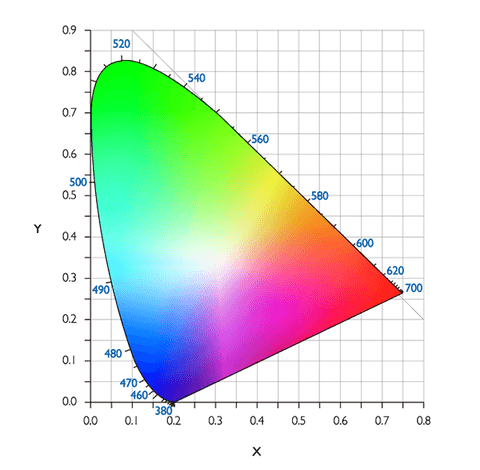
Every time you read a review of a display device, you will see the color triangle as a reference in the color measurement section.
Now let's move on to the color gamuts developed by the video entertainment industry and still in use today.Rec.709 color gamutThis is a standard developed in 1990 by the ITU (International Telecommunication Union) for high-definition television (HDTV) and digital video transmission.
The Rec.709 color gamut covers only about 35.9% of the visible color spectrum (CIE 1931).
Keep in mind that for the past 30+ years, every film we've watched in HD (720p & 1080p) has displayed color reproduction that reaches only 35.9% of the colors our eyes can perceive.DCI-P3 color gamutDCI-P3 was established in the early 2000s by the Digital Cinema Initiatives (DCI), a consortium of major Hollywood studios, as a color gamut standard specifically for digital cinema projection systems and was released in 2007.
The DCI-P3 color gamut covers only about 45.5% of the visible color spectrum (CIE 1931), which is approximately 10% more than the Rec.709 color gamut.Rec.2020 color gamutAnd now we come to the latest color gamut standard from the ITU (International Telecommunication Union) from 2012, Rec.2020, also known as BT.2020. This standard was developed for ultra-high-definition television (UHDTV) and the latest generation of video transmission.
The Rec.2020 color gamut covers approximately 75.8% of the visible color spectrum (CIE 1931).
Rec.2020 was designed to overcome the limitations of earlier standards (such as Rec.709) by significantly expanding the color gamut to cover a wider range of colors. This expansion was intended to enable advances in display technology and provide consumers with a more immersive and realistic viewing experience.The three color standards in the CIE 1931 diagram
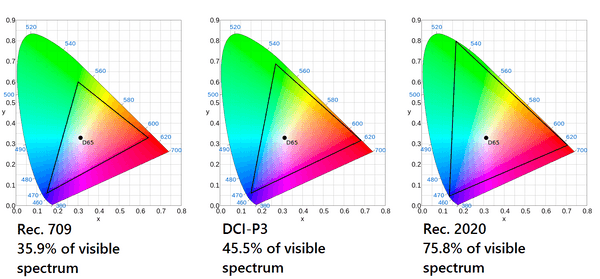
Development of display technologyAdvancements in color reproduction in the video industry and digital imaging have made significant progress with the introduction of standards such as HDR10 and Dolby Vision, as well as new color standards like the Rec.2020 color gamut.
Of course, very few digital displays today can reproduce a color range that reaches 75.8% of the visible color spectrum and covers 100% of the Rec.2020 standard. Even 12 years after the introduction of the Rec.2020 standard, there is no consumer television technology capable of reproducing 100% of the Rec.2020 color gamut.RGB laser technology and color gamutThe revolution in RGB laser technology brought by laser TVs has enabled the full reproduction of the Rec.2020 color gamut, and in some cases, even surpassed it!
The AWOL VisionLaser TV UST projectorsWith their advanced pure RGB laser technology, they not only fully cover the Rec.2020 color gamut, but even exceed it by 107%. This corresponds to more than 81% of the visible human color spectrum! It is truly impressive.
Genuine screenshot – AWOL LTV-3000pro

Do you know...What exactly is a color gamut, and to what extent does a display device reproduce the natural color spectrum according to its specifications?
What is the difference in color performance between a display device that covers the Rec.709 or DCI-P3 standard and one that covers the Rec.2020 standard?
Now you know!
AWOL Vision Technology
Discover More Insights